• Skip to primary navigation
  • Skip to main content
  • Skip to primary sidebar
  • Skip to footer

Potomac Kempo

  • Adults
  • Kids
  • FAQ
  • Locations
  • About Kempo
  • Student Profiles
  • 2026 Summer Camp

martial arts

Three Awarded Fourth Degree Black Belts at Potomac Kempo

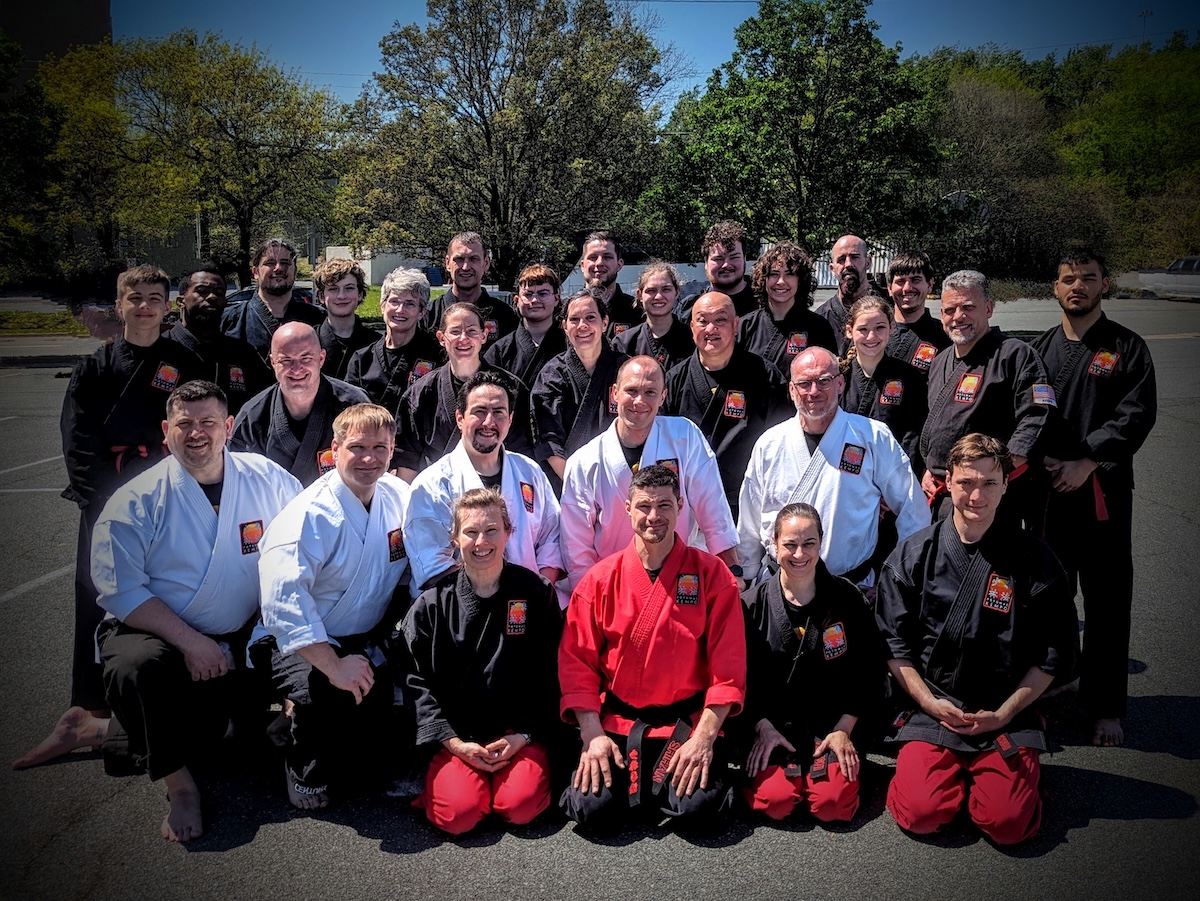
Potomac Kempo - Santillo Simpson Gibbs Jelsma - Fourth Degree Black Belt

Sometimes the best amongst us are the humblest, which is certainly the case with these exemplary martial artists.

For many people, the practice of martial arts is a strange—possibly intimidating—concept. People often wonder what happens in a ‘dojo’ with unfortunate misconceptions often perpetuated by movies and television. But the martial arts, and specifically the art of Kempo, which we choose to practice, is not strange or mysterious. It is an ancient self-improvement practice with fitness training and self-defense fitted in to fill out the edges.

In life, we often find that our greatest adversary is ourselves, as we all too often stand in our own way—sometimes going so far as to sabotage ourselves actively. But in Kempo, we work to overcome these traits by developing and utilizing methods that work in the studio and as well as in other aspects of life. By doing so, we work to create well-rounded, successful, and healthy lives.

In this spirit, we wish to acknowledge the accomplishment of three of our most esteemed students. In December 2021, Kevin Simpson, Jon Jelsma, and Geof Gibbs earned their Fourth Degree Black Belts in the Art of Kempo. They are the first students to reach this level in Potomac Kempo’s seventeen-year history, representing less than one-tenth of one percent of our students.

These gentlemen have practiced the martial arts for an average of twenty years, teaching as well as training, and have studied multiple arts.

In addition to his Kempo practice, Kevin Simpson has studied Ninjutsu, Hapkido, Brazilian Jiu-Jitsu, and Army Combatives, in which he is a Level 2 Certified Instructor. He is a Sergeant First Class in the US Army Band, and he volunteers to teach both Kempo classes and grappling basics.

Before practicing Kempo, Jon Jelsma studied Tae Kwon Do, Shorin Ryu Karate, and Fencing. Amidst his Kempo practice, he has also studied Jeet Kun Do, Pekiti Tirsia Kali, Inosanto Academy Kali, and Kosho Ryu Kempo. He is a patent examiner for the US Patent and Trademark Office and volunteers to teach Kempo and Kali classes throughout the week.

Geof Gibbs began his martial arts practice with Kempo and has since come to supplement it with the study of Kali and Kosho Shorei Ryu. Having left a former life as a computer scientist, he is now a career instructor, acting as our Senior Staff Trainer and the Chief Instructor of our Huntington Metro studio location in Alexandria, Virginia. In addition to teaching Kempo, he leads our Kosho Club. Consistent with our relatively new tradition of passing on belts, Geof was presented with my own Fourth Degree Black Belt that I wore when I was that rank.

We are honored by their accomplishments and are proud to have them as part of the Potomac Kempo team. It is rightly said that “You are only as good as the people you train with,” and these exemplary practitioners are an asset to all of Potomac Kempo. Their work is a testament to lifetimes of dedication, learning, and growth.

One final thought:

As I sat on the floor of an empty studio presenting belts to three very sweaty persons, I searched for words to capture the moment, for praise that would not seem redundant or superfluous. My mind circled twice, and I settled back on humility. I have known these men for decades; we have spent more hours training together than I could begin to count. They are my most accomplished students, yet they may also be my most humble students. And I don’t think that is an accident or coincidence. In martial arts, we tell the story of a student whose cup is so full it will not hold any more tea. Through all of these years, Kevin, Jon, and Geof have all managed to keep an empty cup, space to learn, never believing that they have learned it all.

I wish them a lifetime of continued success and health.

Chris Santillo, Sensei
Potomac Kempo
Founder, Headmaster
Godan, Shihan, Master, Guru

Potomac Kempo Simpson Gibbs Jelsma Fourth Degree Black Belt

The Long Way to Belgium

The Long Way to Belgium

Our path to Belgium started a decade ago in Pennsylvania. Obviously.

One of my students was headed to a martial arts seminar in Pennsylvania. I reached out to the host, and he graciously invited me to join the roster of instructors. It was a humbling experience, and I say without reservation that I learned far more than I taught and am still a student of the host, Sensei Jeff Driscoll, Kyoshi.

While in Pennsylvania, I met another of Sensei Driscoll’s students, Sensei Bart De Backer, Shihan. He, in turn, invited me to join with the other instructors at a seminar that he hosted. Again, it was a humbling and enlightening experience to be amongst such a host of skilled martial arts professionals.

Potomac Kempo - Santillo - The Long Way to Belgium

While at Sensei De Backer’s seminar, I met Sempai Bart Matthijs, Sempai Bene Laloo, and Sensei Rik Moelaert, Renshi, who, many years later, invited me to teach at their event in Belgium this Fall. This seminar was in honor of Shinkai Kempo Karate’s Tenth Anniversary and was impeccably professional and impressively international.

Instructors from five different countries gathered to inspire students of all ranks and ages to achieve a new level of martial arts understanding. Here was a chance to interact with the larger world of martial arts and see that, even in a different country, with instructors speaking many different languages, we have a common language of martial arts principles.

In addition to being a rewarding intercultural and educational experience, this seminar was particularly memorable because I had the privilege of sharing it with Sensei Gary Covington, Sensei Geof Gibbs, and Sensei Kevin Simpson, who flew across the Atlantic for the opportunity to participate.

Potomac Kempo - Santillo - The Long Way to Belgium
Potomac Kempo Family Reunion in Belgium

Furthermore, we were all the more delighted when the host instructors invited us to guest teach Shinkai’s next evening of classes. Sensei Holly Santillo, Renshi taught the children’s classes, and I led the adult classes. What a wonderful group of enthusiastic students! It was a delight and a joy to get to work with them.

There may be many ways to get to Belgium, but the most direct way seems to be to meet people, make friends, and accept invitations. Regardless of where opportunities and invitations arise, if you have the chance to participate in such events, I encourage you to do so! Spending dedicated time immersed in the practice of martial arts, surrounded by people of similar passion, is truly fulfilling.

And you never know where it might take you!

Respectfully and gratefully,
Sensei Chris Santillo, Shihan

Potomac Kempo - Santillo - The Long Way to Belgium

Relax, you’re falling.

What do you think about as you fall headfirst towards the ground?

Or, more to the point, what should you think about?

If the surface is pavement or gravel?

Should you tense for impact?

No, obviously, you should just relax.

In the case of falling, as in so many instances, our instincts are flawed. If you are falling towards the Earth, you should not tense for impact. Instead, relax and roll with it. Fall intentionally. There is no guarantee that you won’t be injured, but rolling with a fall will minimize its impact. And make no mistake, it is a skill best practiced in advance.

And so we practice, class after class. In the dojo and hopefully at home too, we practice falling and rolling forward, backward, to the side, with a twist, with only one leg, blindfolded, and while holding a glass of water. We practice these skills so that when we find ourselves heading towards the ground more precipitously than intended, we can bring ourselves to rest safely.

It might be worth noting that, despite our martial framework, in life we are much more likely to fall towards the ground for a banal reason than as the result of an attack. We sometimes stumble over a curb, trip amidst a friendly game of soccer, jump over one of our children, or comically slip on a banana peel. But falling is falling whether someone threw you down or you fell of your own accord. Relaxing and going with energy is always the best way to prevent or minimize injury.

Let’s go further. As is so often the case when discussing martial principles, I am compelled to find the broader application of a particular practice.

In this instance, we can consider the ground to be a difficulty, obstacle, or challenge. We are so often tempted to tense as life’s little speed-bumps come hurtling towards us. But that seldom does us any real good, and much more often does us actual harm. When we become rigid in preparation for conflict, we are bracing for when and where we believe we will take the brunt of the impact. But life—and rolls—are seldom like that.

We often like to rehearse important conversations in our head, maybe asking for a promotion, requesting a grade be revised, or discussing a political position. But to the extent that we believe we have structured the conversation in advance, we have degraded our ability to feel the conversation as it unfolds and respond appropriately in real-time.

If we’re nervous about anticipated pain—perhaps getting an injection—your tension will make the pain worse by double. Tensing a muscle causes the needle to cut more fibers, not fewer. Here, as in so many instances, we are best served by breathing and relaxing. It’ll only last for a moment. 

Inevitably the real force that we encounter is from a slightly different place, time, or direction than we anticipated. And stay with me—this is the whole point—to the extent that we brace for one kind of impact, we make ourselves more vulnerable for all others.

As we tumble to the ground, we may believe that we know precisely when we will hit, at what angle, and how much the ground will—or won’t—give. We’re never quite right.

Instead, our best bet is to feel the impact and relax around it—exhaling and dynamically structuring our bodies in a slowly expanding curve while tucking in our pointy bits. 

No conversation will ever go as planned, and no two will ever be the same. In the same way, no fall will ever go as you anticipate, and the ground will never be the same twice. 

So relax.

Potomac Kempo - Chris Santillo - Relax youre falling
Photo credit: Cascades Photography. Click here for the complete video.

Singleness of Purpose – Overcoming Life’s Obstacles Without Punching

Some people describe a punch in terms of the structure of the body that supports and projects the arm and fist. Others harken to the term “throwing a punch” and explain that a punch is led by the hand and that the body needs but to form behind it. Of course, they are both correct as far as each goes. However, I like to take a step further back, beyond the body and to the mind that initiates the idea of the punch in the first place. 

A punch begins with a thought. An intent and a target create motion from stillness. The idea propels the fist and simultaneously structures the body behind it. To the extent that the individual understands and is well practiced in the posture, skeletal alignment, and muscular fluidity necessary for a strike, the punch will come into being to fulfill the intent created by the mind. 

Singleness of Purpose - Overcoming Life's Obstacles Without Punching

If all of this sounds esoteric, that’s because it is.

But everyone who has ever practiced has had moments when a strike was better (or worse) than the physical input should have made it. Inevitably, it was the mind overplaying (or underplaying) its role that created the mismatch. 

But what about all of the moments in life when we’re not punching people?

I’m glad you asked. As you have probably noticed, there are surprisingly few problems in life that can be solved by punching. Most issues need a much more subtle approach. Luckily, there is a direct translation between the skills associated with punching that you practice in your martial arts studio and the methods appropriate to solving and overcoming the other problems and challenges that life presents you with. 

In particular, the notion that the execution of a strike is initiated by the intention in the mind and formulated through the whole being as a single unified action directly translates into daily life. In this way, when we are confronted with a difficulty—be it an assignment at work or school; an interpersonal conflict with a friend, colleague, or stranger; or a developing a legacy project—you can apply the same single-mindedness of purpose that you practice with every punch you throw.

By so doing, you align your entire being behind your purpose. You bring not just your physical body but the greatest intentions of your mind and also the formidable powers of your spirit to bear on the problem at hand. And when you do, few things can stand in your way.

Except when it doesn’t work.

It is worth pointing out—and it’s worth writing a separate blog post discussing—that it doesn’t always work. In the same way that a powerful, focused, targeted strike will not settle all physical confrontations, a direct approach will not overcome all of life’s challenges. And in those instances, it is our ability to be flexible that will help us to prevail. 

But let us leave those greater subtleties to another day. Today let us simply relish the feeling of strength that we feel when we fully align our mind, body, and spirit and appreciate how much we can accomplish when we do so.

Our Mission

Our Mission is to positively impact the world by inspiring excellence in the men, women, and children we serve — challenging them to become healthier, happier, and better through the practice of the Martial Arts.

Potomac Kempo Mission Statement

I believe firsthand in the power of these words. A mission statement is an organization’s effort to articulate its purpose to the world and, though our mission statement serves that purpose, it began simply as a personal quest. 

Potomac Kempo - Our Mission
Visiting the Shaolin Temple, Henan, China in 2001

The word, “healthier,” hearkens back to my earliest days as a martial artist. Not long after first putting on my white belt, I began to experience the benefits that practicing martial arts has to offer. The conditioning I acquired through my training afforded me well-rounded physical well-being that elevated my abilities in many other activities. I could hike, bike, run, climb, and endure challenges with grace and aplomb while feeling vibrant and healthy.

Finding this mastery of my body led me to discover the possibility of possessing similar results with my mind. I could better stay on task, work toward long-term goals, and modulate my internal states. I became happier. I came to believe that anything was possible. 

The concept of being “better” evolved more slowly, and couldn’t become clearly articulated until I laid down the Pillars of Kempo, much later in my career. I feel that the Learning, Integrity, and Service integral to the martial arts are the foundation for building a better life. In the absence of Learning, we are empty; we lack the substance from which to build a life. We must be open to that Learning, in the dojo and beyond. Building a solid life requires Integrity — being honest and fulfilling our obligations. And through Service, we give that life significance.

Potomac Kempo - Our Mission

As I became an instructor, I was able to see my students experience these same benefits. Later, my wife, Holly, became a student and eventually our children, too, began their training. As I write this now, I can appreciate the benefit of martial arts training as a student, an instructor, a partner, and a parent. And I love it. 

Potomac Kempo - Our Mission

This life is a shared experience. We live alongside all the other people in our world, and we are continually impacting them — either for better or worse. By elevating ourselves through our martial arts training, we can, in a very real sense, make the world a better place. From one person to many, we change the world by sharing the lessons Kempo teaches us. 

It is worth noting, though, that I can do none of this by myself; nor can Potomac Kempo. It is only through our students that we can change the world. To this end, we challenge our students to rise to the occasion, become the best version of themselves, and join with us in making the world a better place.

Reprising our Mission Statement feels particularly poignant as we celebrate the opening of our fifth school. With love and admiration, we congratulate Renshi Cassie and Mr. Cothran on the opening of our newest location: Potomac Kempo – National Landing. 

Chris Santillo, Shihan
Founder, Head Instructor

Potomac Kempo - Our Mission
Holly being promoted to her current rank

Kempo Essay: Joe

Joe is a seventeen-year-old who has been training for more than two-thirds of his life. As he eludes to, he doesn’t remember a time when he was not a Potomac Kempo student. Recently, we had the honor to promote him to Second-Degree Black Belt, an honor that only a handful of others have achieved before graduating high school. We are very proud of Joe and are excited to see all of the great things he will accomplish in life with this solid Kempo-based foundation.

Potomac Kempo Chris Santillo Geof Gibbs

Kempo has had an immense effect on my life, and I can confidently say that I would be a very different person without the experiences I have had at the dojo. Physically, of course, the practicing of Kempo is the source of much of my exercise, keeping me healthy and fit. This, however, in my opinion, is overshadowed by what Kempo has taught me about life. There are so many real-life lessons that I have learned from my training that I cannot possibly recount them all, so I will share with you a few of the ones that I think are most important. First, there is always a way to improve anything you are working on. Whether it is Kempo two or differential equations, there is always going to be someone who is better at it than you, and if you listen to them, you will improve. This teaches us humility and the value of having a teacher.

Another thing I have learned from Kempo is that to become good at something you need more than the effort put in; you need commitment, enthusiasm, and friends to help you along your journey. The amount of these things I have had has varied along my Kempo journey, and this has shown in my progress. Kempo taught me the importance of these factors, and now I strive to find them in all projects that I pursue. Finally, Kempo has gone even beyond teaching me simple lessons, it has altered my outlook on life. I cannot truly say what I would be without Kempo because I barely remember a time before I started training, but I know that Kempo has taught me patience over the years. And that putting in lots of effort for a distant reward is worth it eventually. It takes practice to remember a Kempo, even more, to be able to do it well. The same is true for life and Kempo helped to demonstrate this for me beyond what other experiences ever could.

Thank you for teaching me,
Joe

Potomac Kempo Chris Santillo

  • « Go to Previous Page
  • Page 1
  • Page 2
  • Page 3
  • Go to Next Page »

Primary Sidebar

Please join us for a complimentary class!

Call or text Geoff at ‭(571) 336-7021‬ or complete this short form and an instructor will contact you.

Loading


Testimonials

Kempo has helped me to focus. The discipline has helped me to be a better student in school. I am very determined. In the future, I will know to work hard.

— Six-year-old Purple Belt


Our Locations

Potomac Kempo - National Landing

National Landing
3650 S Glebe Rd 190
Arlington, VA 22202
Call or text Jonathan at
(571) 412-8585

Potomac Kempo - Old Towne

Old Towne
2050 Ballenger Avenue
Alexandria, VA 22314
Call or text Leo at
(571) 336-7010

Potomac Kempo - Huntington Metro

Huntington Metro
5914 N. Kings Highway
Alexandria, VA 22303
Call or text Geoff at
(571) 336-7021

Potomac Kempo - Fairlington

Fairlington
1535A N Quaker Lane
Alexandria, VA 22302
Call or text Colton at
(571) 336-7063

Potomac Kempo - Kingstowne

Kingstowne
5958 Kingstowne Ctr #110
Alexandria, VA 22315
Call or text Gary at
(703) 206-8064


Footer

Potomac Kempo Instructor Photo

Home Page

Potomac Kempo - Adults

Martial Arts for Adults

Potomac Kempo - Kids

Martial Arts for Kids

Potomac Kempo Studio Locations Alexandria Virginia

Studio Locations

Potomac Kempo - Take a Breath and Keep Practicing

Take a Breath and Keep Practicing

At the Shaolin Temple, we had the privilege of training with a senior monk possessing the congenial, relaxed demeanor that so often accompanies mastery. Working in a back alley behind the ancient curved rooftops, watched only occasionally by resident (indifferent) cats and our taciturn teacher, we aimed to make our bodies mimic the skills being […]

More articles about Kempo

  • New Year, Stronger Foundations: How Kempo Builds Resilience
  • Reclaim Your Vitality: How Martial Arts Ignites Energy, Strength, and Well-Being
  • The Balance of Humility and Pride: Lessons from Kempo
  • From Challenge to Triumph: The Martial Arts Mindset
  • Three Complementary Training Methods for Martial Arts Success
  • Balance in Workouts: The Shaolin Crane Way
  • The Capitol Tournament Returns!
  • Three Awarded Fourth Degree Black Belts at Potomac Kempo
  • The Long Way to Belgium
  • Relax, you’re falling.
Potomac Kempo - Emily

Kempo Essay: Emily

I have two wonderful daughters and a wonderful husband. I have full time job that is challenging and, I believe, meaningful. As a mother, wife, and leader I have a lot of responsibilities and keep very busy. I needed a little time and an opportunity to focus on being a better me – to take […]

More Student Profiles

  • Kempo Essay: Emily
  • Kempo Essay: Marta
  • Kempo Essay: Jordan
  • Kempo Essay: Ally
  • Kempo Essay: Lisa
  • Kempo Essay: Auna
  • Kempo Essay: Sara
  • Kempo Essay: Ricky
  • Student Profile: Brett
  • Student Profile: Rachel & Jonathan

Copyright © 2026 · Executive Pro on Genesis Framework · WordPress · Log in